Radio Free Generation: A Guide To R.E.M.

Standard


The origins of this guide predate my ever doing these discographies in the first place.  They date back, in fact, to September 22nd, 2011, to the day that the band officially called it quits (until they all discover big expenses later in life, anyway), and to the news item published by Gawker that day.  It was a Brian Moylan piece, of course, so it was needlessly snarky and a little obsessed with its own cleverness.  The piece referred to R.E.M. as a “90s indie sensation” that people “hadn’t thought about since Automatic For The People“.  It also called Fables Of The Reconstruction  “the good old days”.  There may be band breakup articles that got it more wrong, but I’d be hard-pressed to name any.  I wanted to sit down and write out the defence of the band as the Great American Sensation that they were, the definitive first band to rise up out of Generation X’s early obsession with music scenes to conquer mainstream radio, paving the way for the Grunge Revolution and everything that came after.  Then I realized that their comment forum was a bad place to say just about anything, and shelved it for another day.  Today, however, is a different day.

R.E.M. first appeared in the Athens, Georgia scene in the early 1980s.  Athens is a college town, hosting a campus of the University of Georgia, and it has been a reliable music mine, giving the world the B-52s, The Whigs, Indigo Girls, Widespread Panic, Matthew Sweet, Danger Mouse, Harvey Milk, and the entire Elephant Six collective.  In 1980, Peter Buck and Michael Stipe met at a local record shop, where Stipe kept buying all the records that Buck, who worked there, was putting aside for himself – both of them, as it turned out, were fans of Television’s Marquee Moon.  They met Mike Mills and Bill Berry, a rhythm section of university kids who spurred Buck and Stipe into making music together.  It was all very casual at first, of course, but when the crowds they drew began to dwarf the rest of the scene, it became suddenly much more real.  They had something special together, a spark that drove them to become Generation X’s first real college rock heroes.

I went to the only record shop in St. Catharines the other day, looking to fill up my collection, restless to dig through stacks.  I came out with four records:  The Texas Campfire Tapes by Michelle Shocked, Station To Station by David Bowie, Remain In Light by Talking Heads, and Lifes Rich Pageant.  When he was jotting together the total, the proprietor told me that there had been a time when he’d fallen out of love with rock ‘n’ roll, but that the Smiths and R.E.M. had brought him back into the fold.  That’s the kind of spark they have, the sort of ambitious sound that bridges divides and saves souls.
https://open.spotify.com/user/1242975014/playlist/0HCvJdUWJW7b45PNJyYNBZ

r-e-m-murmur-front

Murmur

★★★★★

Released April 12th, 1983 on IRS Records

#36 on the Billboard Top 200

“Radio Free Europe”: #78 on the Hot 100

Murmur is the album that has been summed up as “Gen X Goes To College”.  It’s a cryptic, deliberately hazy album, the birthplace of the descriptor “jangly” which has been overused to describe primarily the guitar sound found here.  That sound – perhaps the most important kick-start for the “alternative nation” – came about because of a bad experience the band had with producer Stephen Hague.  Hague had tried to get the band to concentrate on technical precision and cutting-edge technology, going so far as to add in keyboards to the original recording of “Catapult” without the band’s permission.  Upon finally getting their way with IRS, the band brought in Mitch Easter, who had done the production on Chronic Town, their scene-breaking EP from the previous year.  Easter let the band record as they wanted; in a fit of pique after their experience with Hague, this meant that they decided to eschew guitar solos, contemporary synthesizers, and the sort of big-sound recording flourishes you’d typically have expected from an LP in 1983.

The result was a moody, swirling album, but less moody than contemporaries like The Cure or anyone else who was positioning themselves as an ‘alternative’ to the big-rock Zeppelin and Purple chasers who were even then bringing mainstream rock to a shuddering stand-still.  It was still structured like a traditional mainstream rock album, to be sure – guitars and vocals up front, rhythm section swinging away in the background – but instead of high-gain shred heroics and riffs that drank from the well of Tony Iommi, R.E.M. put together songs made out of chiming guitars straight out of the Byrds catalog, with clean, punchy bass to back them up.  Instead of an up-front caterwaul dripping with overt masculine sexuality, Michael Stipe kept things mushy, indistinct, and obstinately obscure.  Stipe, from Murmur onward, became the poster boy for mysteriousness in rock ‘n’ roll, penning lyrics that were couched in oblique metaphors and blending them into the songs as another instrument among equals.  Put together, Murmur is a timeless album, crafted out of a number of genres but owing fealty to none of them.

r-e-m-reckoning


Reckoning

★★★★☆

Released April 9th, 1984 on IRS Records

#27 on the Billboard Top 200

“So. Central Rain” – #85 on the Hot 100

Taking a step forward from the pioneering sound of their debut, Reckoning found the band trying to capture the essence of the sound of REM playing live.  As a result, there was more of an effort to “rock out” on this album, an attempt to clean up the haziness of Murmur while keeping the singular songcraft that had marked the band out as something much different than their Athens contemporaries.  They went back to that original EP, Chronic Town, for inspiration, mining it for another go-around at jangly guitar pop that seemed to come straight out of the garage.  It was cripser, and somewhat more comprehensible, but at the same time it was lyrically a bit darker than the vague hash of poetry found on Murmur.  Part of the album’s sound is due to the fact that Murmur hadn’t sold to IRS Records’ expectations, and the powers that be at the label were looking for a more commercial album.  The band responded by making things bigger, cleaner, and punchier – Bill Berry’s drums in particular stand out much more than they did on the debut.  Part of the album’s sound is due to a violent storm that lashed Athens during the recording, resulting in the death of friend-of-the-band Carol Levy.  The aftermath resulted in an abundance of water imagery, notably on the wrenching “So. Central Rain (I’m Sorry)” and “Camera”.  “Pretty Persuasion” and “(Don’t Go Back To) Rockville”, were a couple of Chronic Town-era compositions whose rootsy rock incidentally gave birth to the Tragically Hip.

Reckoning is a part of the DNA of the alternative movement, putting Murmur‘s jangle-pop into a much flashier setting and paving the way for all of the chiming, rootsy college rock bands that would follow in its wake.

R.E.M._-_Fables_of_the_Reconstruction


Fables Of The Reconstruction

★★★☆

Released June 10th, 1985 on IRS Records

#28 on the Top 200

“Can’t Get There From Here”:  #14 on the Hot 100

“Driver 8”:  #22 on the Mainstream Rock Chart

After Reckoning the band decamped to London and switched up producers to Joe Boyd, who had previously worked with Nick Drake and Fairport Convention.  They chose to use their time in England to explore the geography and the mythology of the American South, crafting their own southern gothics influenced mainly by their travels across the landscape during the near-constant touring they’d gone through in the course of their first two albums.  “Feeling Gravity’s Pull” represented a different sort of opener; dark and bouyed by a string section, it referenced surrealist photographer Man Ray and falling asleep while reading.  “Driver 8” was awash in railways and trains; “Maps and Legends” paid homage to Rev. Howard Finster, an Alabama artist and Baptist minister who’s art adorned the cover of Reckoning.  “Life And How To Live It” referred to Brvis Mekis, who self-published the book of the same name and kept every copy in his closet.

These were all fine concepts for an album, but Fables Of The Reconstruction played them out in a slow, dragging sort of half-time version of what they’d polished on Reckoning.  Aside from the rollicking “Can’t Get There From Here” the songs limp along in a dour funk.  Whether the sound stems from the exhaustion the band must have felt after three years of crossing the country or from the mood-altering English weather, it mars what could have been a much better album.  Bill Berry was of the opinion that it sucked, a decade after its release; Michael Stipe agreed at one point but he has come around on it, claiming a love for it.

Rem_lrp


Lifes Rich Pageant

★★★★

Released July 28th, 1986 on IRS Records

#21 on the Billboard Top 200

“Fall On Me”:  #5 on the Rock chart, #94 on the Hot 100

“Superman”:  #17 on the Rock chart

Recorded in Indiana, Lifes Rich Pageant shows REM’s first steps towards a much more expansive, arena-filling sound.  Dan Gehman, John Mellancamp’s producer, brought them to his bosses Belmont Mall Studio and brought out the crisp snap present in Bill Berry’s drums, let the bass dance on top of it, and managed to tease out the pop melodies inherent in Michael Stipe’s vocals.  It serves as the final chapter of their early college jangle and as the first chapter of their work as one of the leading lights of the more widescreen ambitions of the alternative movement.  Christgau called it “music for mushheads” but this was the sharpest that REM had been to date.  Lyrically it was overtly political, including a newfound interest in ecology (it was the mid-1980s, after all).  “The Flowers of Guatemala” brought out their political side, while “Fall On Me” gave the verse “There’s the progress / We have found a way to talk around the problem / Building towers / Foresight isn’t anything at all / Buy the sky and sell the sky / And bleed the sky and tell the sky”.  “Cuyahoga” follows up on the ecological theme presented on “Fall On Me”, referencing the Ohio river that actually caught fire several times during the 1950s and 1960s due to over-saturation of chemicals from the nearby heavy manufacturing presence.  The most famous song today remains the band’s cover of The Cliques’ “Superman”.  The track features Mike Mills on lead vocals, since Stipe was unimpressed with the idea of covering the song and preferred to defer to the bassist.

130318ed


Document

★★★★★

Released September 1st, 1987

#10 on the Billboard Top 200

“It’s The End Of The World As We Know It (And I Feel Fine)”: #16 on the Mainstream Rock chart, #69 on the Hot 100

“The One I Love”:  #2 on the Mainstream Rock chart, #9 on the Hot 100

“Finest Worksong”:  #28 on the Mainstream Rock chart

Document is the first album produced by Scott Litt, a collaboration that would carry the band through until 1996.  Like Reckoning, it takes the sounds they’d pioneered on the previous album – the big gestures, the snap of the drums, the arena-ready tone – and brought it closer to the way those songs were performed live.  Document is a big album; the songs seem to inhabit the sonic space to their comfortable limits, filling in the corners of REM’s sound in a way they’ve never been able to duplicate since.  As a whole it was even more political than their work on Lifes Rich Pageant.  The band has since acknowledged that many of the songs were a response to the state of Reagan’s America in 1986 and 1987.  “Exhuming McCarthy” conjured up the ghost of the Red Scare’s premier architect, imploring the listener to meet them at the book burning and pointing fingers at those who “bought the myth by jingo, buy American”.  “Welcome To The Occupation”, like “The Flowers of Guatemala”, shook its fist at American military involvement in the fascist regimes in South America.  “Finest Worksong” feels like the opening anthem to a revolution, and “Disturbance At The Heron House” and “King of Birds” follow along in that vein, through the streets and the riots.  “Fireplace” is a cut-and-paste of a speech by Mother Ann Lee, who led the Shakers in the late 18th Century.  The big tracks, of course, were “It’s The End Of The World As We Know It (And I Feel Fine)” and “The One I Love”, both which are now staples on rock radio, as well as film and television soundtracks.  The former, with it’s rapid-fire stream of consciousness vocal, would drive millions to try to memorize the whole thing just to belt it out; the latter, a moodier track in the vein of Murmur, contained some of Stipe’s most vicious lyrics, including the classic “This one goes out to the one I love / A simple prop to occupy my time”. Both hit the Billboard pop chart and carried the band into wider mainstream consciousness for the first time.

Document and I have a thing.  Every year, when the warm weather finally arrives back in southern Ontario, I buy some beer, throw the windows open, and get drunk with the album as a soundtrack.  It’s my spring ritual, and I can’t imagine doing it with any other album.

115741279


Green

★★★★

Released November 8th, 1988 on Warner Bros

#12 on the Billboard Top 200

“Orange Crush”:  #1 on the Mainstream Rock chart, #1 on the Modern Rock chart

“Pop Song ’89”:  #16 on the Modern Rock chart, #14 on the Mainstream Rock chart, #86 on the Hot 100

“Stand”:  #1 on the Modern Rock chart, #1 on the Mainstream Rock chart, #6 on the Hot 100

“Turn You Inside Out”:  #7 on the Mainstream Rock chart, #10 on the Modern Rock chart

After Document, REM had grown sick of their record label.  IRS Records kept pressuring them to sell increasingly more albums; the distributor, meanwhile, didn’t consider the band a priority and made it difficult for them to fulfill IRS’ wishes.  Warner Bros, sensing a growing hit act, reportedly offered the band upwards of $12 million to sign, which they accepted.  The step up to big labels and big budgets came at a time of crisis, and Green proved to be a much different REM album than any that had come before.  Bored with their “assigned” roles, they switched instruments and began jamming with different goals in mind:  new styles, major keys, more exuberant rock songs.  The result was an eclectic mixture of styles that popped out a number of hit singles, prompting some long-time fans to cry “sell-out”.  Peter Buck would later describe it as an REM album without typical REM songs, and the overall collection is not as cohesive as their efforts with IRS Records.  The band labelled the two sides of the album “Air” and “Metal”; Air would be the poppier, lighter songs, and Metal would be much more dour, like the stodgier moments on Document.  Regardless of the overall project, their singles found major coverage on the radio and after the album’s release the band would embark on an exhausting eleven month tour in support of it.

The band would continue with the political statements they’d begun on Lifes Rich Pageant.  The release of Green was timed to coincide with the 1988 American Presidential election; the band was obviously critical of then-Vice President George H.W. Bush and supportive of Michael Dukakis.  “Orange Crush” examined the legacy of Agent Orange in Vietnam War veterans; “World Leader Pretend” blasted the outgoing Reagan administration’s bulldozer foreign policy. “Turn You Inside Out”, meanwhile, examined the nature of the singer and the audience that Stipe was already beginning to question, “Pop Song ’89” found them wondering where to go next in terms of the conversation, and “You Are The Everything” introduces what would become a major staple on future REM releases – Peter Buck’s new mandolin.

rem-out-of-time1


Out Of Time

★★☆

Released March 12th, 1991 on Warner Bros

#1 on the Billboard Top 200

“Losing My Religion”:  #4 on the Hot 100

“Shiny Happy People”:  #10 on the Hot 100

Out Of Time may have been the band’s big commercial album, but it sounded like the first album where R.E.M. had no idea what to do next and were firing in every direction.  Green was a little bit like that, but Out Of Time found them trying like mad to keep up their pop bona fides.  They brought in KRS-One to lay down a verse on the cheesy “Radio Song”, which feels to this day like a dated, forced attempt to keep up with pop circa the last decade of the 20th Century.  “Low” tries to go for a mid-tempo dirge feel and falls flat (something that “Near Wild Heaven”, by contrast, actually succeeds at).  “Endgame” is a nice enough instrumental although it comes off as fluff, filler for a band out of real ideas.  “Shiny Happy People” is the really egregious breach of good taste here, a lame pop confection that stands out as the worst hit single in their oeuvre.

It’s not all bad, of course.  Stipe’s trading in of the political in favour of the personal resulted in some rather emotionally affecting moments, notably “Half A World Away” (which would point the way for their next album), “Texarkana” (which sounds like a cleaner take on something from Fables Of The Reconstruction, and of course “Losing My Religion”, which will likely stand for eternity as the definitive R.E.M. song, and possibly the most misunderstood.  An entire generation grew up thinking that Stipe was making a metaphor about losing his innocence in the increased spotlight of global fame, when the phrase was really just a colourful Southern expression that meant “to flip out and start cussing”.  Still, despite these efforts, Out Of Time remains a sore spot in their classic catalog.
rem-automatic


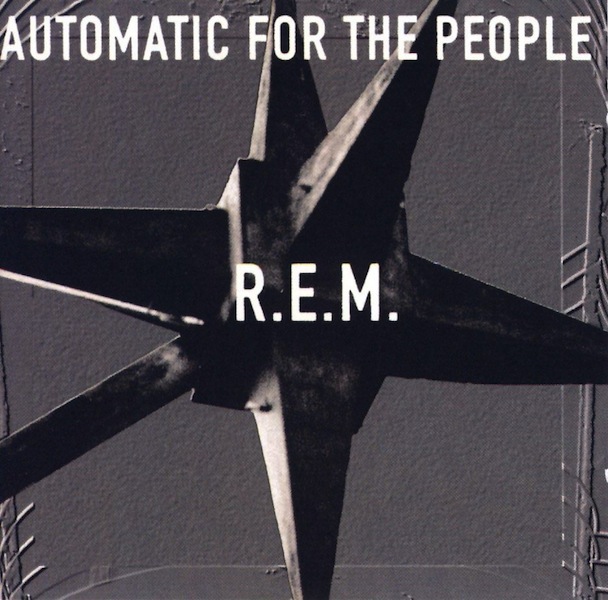
Automatic For The People

★★★★☆

Released October 5th, 1992 on Warner Bros

#2 on the Billboard Top 200

“Drive”:  #28 on the Hot 100

“Man On The Moon”:  #30 on the Hot 100

“The Sidewinder Sleeps Tonight”:  #24 on the Mainstream Rock chart

“Everybody Hurts”:  #29 on the Hot 100

After the exhausting year-long tour behind Green and the scattershot pop explosion of Out Of Time, R.E.M. made the seemingly crazy decision not to tour behind their first #1 record.  Instead, they buckled down and went back into the studio to record the follow-up.  In many ways the years 1991-1992 were a major turning point for the group as artists.  They turned 30 and realized that the underground scene that they’d grown up in during the 1980s no longer existed.  By 1992 Husker Du was gone, and the Replacements were crumbling to nothing.  The glammed-out pop-metal scene to which they’d originally been such a powerful antidote was a bad joke, replaced in the hearts of the adolescent consumer block by grunge, hip hop, and R.E.M.  Driven by this rather somber realization, they cut out the candy-pop shenanigans and trend-chasing that had marred Out Of Time and made a spare, intimate, and very mid-tempo album.  Automatic For The People (named after the slogan of Weaver D’s Delicious Fine Foods in Athens) is, then, the peak of R.E.M.’s powers as rock ‘n’ roll’s premier ballad machine. Led by “Drive”, the album runs through a series of introspective ballads formed out of disconnection, failure, and loss.  “Man On The Moon” – one of only three up-tempo tracks present – mourns for Andy Kaufman; “Everybody Hurts” strives for a universal experience and nails it; “Monty Got A Raw Deal” examines the downward spiral of actor Montgomery Clift, whose car accident in the 1950s led to being mired in drugs and obscurity; “Try Not To Breathe” talks about the acceptance of mortality and the defensive posture of “having lived a good life”.  “The Sidewinder Sleeps Tonight” was put on the album to break up the rather gloomy mood present throughout, and in this it succeeds admirably; the track manages to be bouncy pop fun without stooping to the level of “Shiny Happy People”.  The band would come close to achieving the sort of quality they established here, but they would never quite hit this height again.

Of musical note is the presence of Peter Buck’s mandolin, perhaps never more present elsewhere than it was on Automatic For The People.  Led Zeppelin bassist John Paul Jones provided the gorgeous string arrangements for “Drive”, “The Sidewinder Sleeps Tonight”, “Everybody Hurts”, and the gorgeous, shimmering nostalgia trip of “Nightswimming”.

1035x1035-rem-1800-1397052892


Monster

★★☆

Released September 26th, 1994 on Warner Bros

#1 on the Billboard Top 200

“What’s The Frequency, Kenneth?”:  #21 on the Hot 100

“Bang And Blame”:  #19 on the Hot 100

“Strange Currencies”:  #47 on the Hot 100

“Crush With Eyeliner”:  #20 on the Modern Rock chart

Despite the commercial and critical success of Automatic For The People there was no tour behind it either.  Instead, the band met in early 1993 to figure out where to go next.  The consensus was to make a new album and tour behind it, as though they were some sort of normal band of plebs.  Bill Berry stuck his hand up and requested that they make a more rock-oriented album, something to break up the mid-tempo path they’d been on since 1991.  As such, they intentionally designed Monster to be an album of simple arrangements and the sort of loud, distorted guitars that were clogging up the airwaves at the time.  Stipe designed it lyrically to allow himself to take on the role of multiple characters, so that he could deal with the nature of fame and celebrity.

The recording process was apparently quite tense, with tempers flaring often.  At one point in the process, the band briefly broke up and then reunited.  Two of Michael Stipe’s friends, River Phoenix and Kurt Cobain, died during the process – Phoenix from a drug overdose caused by speedballs at L.A.’s Viper Room, and Cobain from a self-inflicted shotgunning at his Seattle home.  “Let Me In” was written in tribute to Cobain, while River’s sister Rain was brought in to sing back vocals on “Bang And Blame”.

I read an article once where it was revealed that Monster was one of the albums most frequently found in used record store’s bargain bins (another one of those albums was Last Splash by the Breeders, so take all of this with a grain of salt).  The problem with Monster is that the singles are great, and the rest of the album isn’t.  In a way, it’s an example as to why, less than ten years later, music piracy would be such a big deal:  casual listeners were drawn in on the strength of a radio single and discovered that there was a lot of filler to skip over in exchange for their $20.  “What’s The Frequency, Kenneth?” is the strongest song on Monster, to be sure, with it’s examination of the sort of paranoids that one can attract as a public celebrity.  “Bang And Blame” and “Crush With Eyeliner” both nail the kind of post-Nirvana alt-rock that the band was going for, while “Strange Currencies” continues on with the type of balladry that they’re best known for, in the vein of “Everybody Hurts” or “The One I Love”.  The rest of it, though, is utterly forgettable.  Tellingly, “Bang And Blame” would be the band’s last song to chart in the U.S. Top 40.

R.E.M. would embark on a tour behind Monster, travelling alongside Radiohead (who were supporting Pablo Honey) and Sonic Youth.  Stipe, Mills, and Berry would all develop health problems during the tour.  Berry was the worst off of the three:  at a show in Switzerland in 1995, during the intro to “Tongue”, he collapsed behind his drum set.  It would turn out that he had suffered an aneurysm, which would be the eventual impetus behind his departure from the band after the next album.

rem_-_new_adventures_in_hi-fi-front


New Adventures In Hi-Fi

★★★★

Released September 9th, 1996 on Warner Bros

#2 on the Top 200

“E-Bow The Letter”:  #49 on the Hot 100

“Bittersweet Me”:  #46 on the Hot 100

“Electrolite”:  #96 on the Hot 100

New Adventures In Hi-Fi, R.E.M.’s last great album, was recorded mostly during the tour behind Monster.  As such, it’s primary obsession is with motion, and travel.  The bog-standard alt-rock guitars that made Monster a slog are still there, but they’re neatly tempered with mid-tempo experiments with form and atmosphere, and a dollop of country-rock thrown in for leavening.  The result is, as the title suggests, a cleaner, bigger R.E.M. side that begins the lean towards adult contemporary sounds.  Stipe leaves the mumble and mystique of his youth behind for good, finally projecting his voice towards the back of the stadium, like a preacher exhorting the crowd.  It lends real weight to tracks like “How The West Was Won And Where It Got Us” and “Bittersweet Me”.  “The Wake-Up Bomb” is one of the most criminally unappreciated songs in the band’s catalog – in terms of a late-period example of how well the band could do loud rock ‘n’ roll, it’s perfect.  “Electrolite” is another shimmering, beautiful track, like “Nightswimming” with more studio trickery.  “E-Bow The Letter” is one of the best songs to have been written in the 1990s – graceful, gorgeous, cutting-edge, and featuring Patti Smith on backing vocals.

It would be the last album Bill Berry would be the drummer on, as well as the last album Scott Litt would produce.  It goes without saying, perhaps, that the band would never be the same again.

328373149_d41a7c8397_o


Up

★★★☆

Released October 26th, 1998 on Warner Bros

#3 on the Top 200

“Daysleeper”:  #57 on the Hot 100

Exit Bill Berry, and enter a series of session drummers and drum machines.  The rest of the band chose to soldier on and figure out how best to go about getting on without him, and they chose to follow the late 1990s into incorporating electronic sounds into their songs.  The result is a brittle, fragile sounding album, R.E.M. songs built on gossamer and thin thread.  AllMusic called it “easy to admire, hard to love”, and while I tend to agree with that statement I think that there is something muted and beautiful about Up.  They weathered the trend of putting electronic flourishes into songs rather well, much better than some of their Eighties contemporaries like U2.  The band was always good at ballads, which may go a long way in explaining why Up succeeds.  At any rate, it staved off the decline for a whole album longer than would normally be expected for a band in their position, and with the album’s examinations of the clash between the religious or spiritual with the force of science and technology, they used their newfound electronic influences to say something interesting about the modern age.

51NZ7Qr1vGL


Reveal

★★

Released May 14th, 2001 on Warner Bros

#6 on the Top 200

“Imitation of Life”:  #83 on the Hot 100

More robust and melodic than Up, Reveal attempted to capture what the band thought of as the classic R.E.M. sound, only with more light, sunny breezes, and Beach Boys 45s.  It was deliberate and calculated and honestly not all that good.  “Beat A Drum”, “Summer Turns To High”, and “Beachball” are all written as homages to the Beach Boys, and are about as bland and inoffensive as you can imagine.  “Imitation of Life” served its place as a single, but there’s not much to it beyond a recognizably nostalgic melody.  The only real interesting song on the album is “Disappear”.  During a period of time when Radiohead’s Thom Yorke was suffering from intense stage fright, Stipe gave him some good advice about how to deal with it; this advice later inspired Yorke to write “How To Disappear Completely”.  “Disappear” was Stipe’s inspiration based upon the Radiohead song.  Come to think of it, that story is really the only interesting thing about the song.  Reveal didn’t progress the band, and its adult-contemporary sound didn’t win them any new fans or convert any casual fans into followers.

rem_around_the_sun_a-500x500


Around The Sun

★☆

Released October 5th, 2004 on Warner Bros

#13 on the Top 200

About as inessential as you might imagine.

I once had a conversation that went like this:

A:  “Out Of Time is the worst R.E.M. album”

B:  “Have you never heard Around The Sun?”

A:  “It only gets a pass because it’s after Bill Berry left, and who cares about those albums?”

Naturally, Around The Sun was the first R.E.M. album to have no singles chart.  That’s because there isn’t even a passably good song on it.  Peter Buck once opined that it was the sound of people who were so bored with the material they were playing that they couldn’t stand it anymore.  It’s an apathetic album, devoid of weight, ideas, and emotional impact.  Every little nook and quirk that gave R.E.M. personality is sanded down into strict, safe Adult Contemporary.  Reveal at least had some bounce; Around The Sun can’t even mange to shuffle its feet.

remaccelerate


Accelerate

★★★

Released March 31st, 2008 on Warner Bros

#2 on the Top 200

One thing you can say about R.E.M. is that they at least recognize when the ship is sinking and try to bail it out.  Accelerate found them stripping down to their essentials and bringing raw guitar back to the forefront of their sound.  It was more propulsive and high-impact than anything since Document, and Stipe hadn’t been as political with his lyrics since Green.  Like the final years of the Reagan administration, the final years of the Bush administration provided him ample fuel for his viciousness.  “Until The Day Is Done” kicks off with the verse “The battle’s been lost, the war is not won / An addled republic, a bitter refund / The business-first flat-earthers licking their wounds / The verdict is dire, the country in ruins”; “Man Sized Wreath” begins with the raw sarcasm of “Turning on the TV and what do I see? / A pageantry of empty gestures all lined up for me – wow!”; “Houston” follows up the tragedy of incompetence that was Hurricane Katrina with the line “If the storm doesn’t kill me the government will”.  While Accelerate doesn’t really recapture the heights of Lifes Rich Pageant or Document, it’s a lot better than it really has a right to be.

rem-collapse-into-now


Collapse Into Now

★★★

Released March 7th, 2011 on Warner Bros

#5 on the Top 200

This is the final R.E.M. album, and in retrospect it feels like it.  There’s a lot of finality to the lyrics here, a lot of summing up and becoming okay with growing old and moving on.  In the best possible way, Collapse Into Now sounds like an R.E.M. album, and while there are weak moments through out, there are more moments that sound like they’d spent a lot of time re-listening to Lifes Rich Pageant. Stipe would again abandon the political he’d rediscovered on Accelerate in favour of more universal themes:  “Discoverer” recounts his arrival in New York City for the first time and is the only openly autobiographical song he’s written; “It Happened Today” finds him claiming his right to speak, after all that has occurred; “All The Best” makes for the perfect farewell for a band going out on a high note.  “Blue” ends in a swirl, with Stipe singing the title, before briefly reprising the intro of “Discoverer”.

Six months later, in September of 2011, R.E.M. would break up, making Collapse Into Now the band’s final statement.  It could have been a lot worse – Around The Sun could have been their final album, and that would have left a pretty sour note ringing down through history.  Collapse Into Now is about as close to the classic R.E.M. sound as you’re likely to get outside of their actual classic albums, and that’s about what you can ask out of a band thirty years into their career that isn’t Swans or the Flaming Lips.

Courtney Barnett – Sometimes I Sit And Think, And Sometimes I Just Sit

Standard

Courtney Barnett – Sometimes I Sit And Think, And Sometimes I Just Sit

★★★★

“Elevator Operator”, the first track on Melbourne slacker-rock almost-icon Courtney Barnett’s new album, tells the story of a guy who decides to shirk off work and the woman who thinks that he’s planning on killing himself.  It’s a quirky little tale studded with the most shockingly mundane details:  references to a specific tram line, an exact account of our protagonist Oliver Paul’s breakfast, specific buildings, pyramids of Coke cans, and a painting of the woman in the elevator so complete that you can smell the cloying, expensive perfume coming off of her.  The second verse on “An Illustration of Loneliness (Sleepless in New York)” features the lines “I lay awake at three, staring at the ceiling / It’s a kind of off-white, maybe it’s a cream / There’s oily residue dripping from the kitchen / It’s art-deco necromantic chic, all the dinner plates are kitsch with / Irish wolf hounds, French baguettes wrapped loose around their necks”.  “Kim’s Caravan” finds her “walking down Sunset Strip, Phillip Island, not Los Angeles / Got me some hot chips and a cold drink / Took a sandy seat on the shore / There’s a paper on the ground, makes my headache quite profound”.

I went to see post-modern political philosopher Jacques Ranciere speak in Toronto a couple of years ago, for a lecture entitled “The Politics of Fiction”.  He described the process of writing as (and I’m paraphrasing here) taking the endless mundanity of regular life and forcing it into the tyranny of the plot.  To bring it back to his political works (Disagreement et al.), there exists a vast, unnamed field we can think of as the anonymous textures of everyday life.  The writer’s job is to take those anonymous textures and separate them into an arbitrary pen, which is to say that the writer must create a narrative out of these anonymous textures such that they become a story lifted out of the endless day-to-day.  It’s important because one of the things that well-meaning but clueless writers try to teach new, nervous writers is that adjectives are dubious at best, and descriptions should be avoided in favour of serving the almighty plot.

Courtney Barnett never listened to the latter group; hers is a much more “political” fiction, as it were.   She is an absolute master of the mundane, of the anonymous textures of everyday life.  Her lyrics are clear-eyed, her delivery deadpan.  This is a woman who can find the sadness and frustration in litter, in trying to impress someone and almost drowning, in trying to figure out whether or not to mow the lawn.  She approaches Dylan in her point-of-fact delivery, but her poetry is less surrealist than his ever was.  Musically it’s college indie rock with a touch of drink-numbed country, wavering between the red-herring crunch of “Pedestrian At Best” and the lonesome sigh of “Depreston” and “Boxing Day Blues”.  There’s nothing particularly original about the arrangements on Sometimes I Sit And Think, And Sometimes I Just Sit, but then again there was nothing particularly original about the arrangements on The Freewheelin’ Bob Dylan – it’s all in the delivery, and the delivery is where Courtney Barnett excels.  She can take an utterly banal sentence like “If you’ve got a spare half a million, you can knock it down and start rebuilding” and have it stand in for all of the bald-faced depression of trying to find a place to live in a troubled, crime-riddled suburb.  It’s what got her first couple of EPs recognized, and it informs her debut with a wisdom completely beyond her years.  The devil is in the details, as they say, but for Courtney Barnett it’s something much more transcendent.

NOW FEATURED ON SEROWORD.COM


Modest Mouse – Strangers To Ourselves

Standard

Modest Mouse – Strangers To Ourselves

★★★☆

It’s a common expression amongst long-time Modest Mouse fans that the band peaked with their debut, 1996’s This Is A Long Drive For Someone With Nothing To Think About, and have been in a slow state of perpetual decline ever since.  Personally, I would say that this is a bit misleading; they peaked on 1997’s Lonesome Crowded West and have been declining ever since.

When Good News For People Who Love Bad News came out, my friend and roommate opined that it was the worst Modest Mouse album yet, which still made it better than most of what had been released that year.  I made the same joke in 2007 when We Were Dead Before The Ship Even Sank came out, and eight years later here I am making it again.  It really is the worst Modest Mouse record – leaving aside their “debut”, 1994’s Sad Sappy Sucker – and while it’s no longer at the point where it’s better than most everything else, it still holds up quite well.

Ever since “Float On” improbably broke the band to a wider audience, their albums have alternated between radio-ready dance friendly numbers and slower, artsier pieces.  “Lampshades On Fire” is the radio ready track here, waking up anyone who dozed off during the snoozy title track that opens the album.  “Shit In Your Cut”, “Coyotes”, and the closer “Of Course We Know” are the more introspective cuts, following in the footsteps of classic songs like “Gravity Rides Everything” and “The Cold Part”.  “Shit In Your Cut” is the worst of the three, being too long by an entire minute and relatively uninteresting besides.  “The Ground Walks, With Time In A Box” and “God Is An Indian And You’re An Asshole” are both classic-sounding Modest Mouse songs; “Pups To Dust” and “The Tortoise and the Tourist” both attempt to hit that note as well but fall relatively flat.  “Pistol” and “Sugar Boats” are more evidence of frontman Isaac Brock’s fascination with Tom Waits, a fascination that became exceedingly clear on the odder parts of Good News.

Lyrically, the theme that Isaac Brock focuses on here is environmental degradation and the impact that the human species has on it.  “Lampshades On Fire” posits the human existence on Earth as a destructive locust party; “Ground Walks” features the line “The world’s an inventor / We’re the dirtiest thing it’s thought about / And we really don’t mind”; “Coyotes” shows mankind as a predator, saying “Mankind’s behavin’ like some serial killer”.  By the time “Be Brave” comes around, he acknowledges that despite our efforts at killing it off, the planet is just too massive to care:  “Well the Earth doesn’t care and we hardly even matter / We’re just a bit more piss to push out its full bladder / And as our bodies float down onto all their rocky little bits / Piled up under mountains of dirt and silt / And still, the world, it don’t give a shit”.  The last track, “Of Course We Know”, takes the widescreen view of our time on this planet, asking “what in hell are we here for?” before realizing that “we just do not know”.

Strangers To Ourselves is actually quite a good album despite being the band’s worst.  Isaac Brock may be slowing down the weird gnarled rock factory with age and sobriety, but he still manages to put indie rock artists half his age to shame.  It may not be AOTY material, per se, but it’s a worthy addition to a legendary band’s canon.

 NOW FEATURED ON SEROWORD.COM

Colleen Green – I Want To Grow Up

Standard

Colleen Green – I Want To Grow Up

★★☆

Once upon a time I had high hopes for Colleen Green.  When she put out her first super lo-fi tracks, back when Milo Goes To Compton was a thing, I thought she was the coolest person in indie rock.  She was living proof that all you needed was a guitar, a drum machine, and a bag of weed, and you too could make emotionally connecting pop music.  It was freeing in a way that made me instantly fall in love.  Then her “actual” debut, Sock It To Me, came out and it fell kind of flat.  Sure, the quirks that made up her songwriting style were there, but everything sounded too professional, as though some hidebound engineer had been sitting in the studio saying “OK Ms. Green, that’s cool and all, but we need these to sound like actual songs.”  I Want To Grow Up is kind of like that as well, but it’s a bit better in that she seems to have grown used to having to write actual songs that normal people can listen to and not be weirded out by.  This makes for some great moments – the two-parter “Things That Are Bad For Me” being the best – but the overall effect is of a jaded Los Angelite channeling Red Album era Weezer.  In other words, a decent listen but pretty ho-hum for all of that.

 NOW FEATURED ON SEROWORD.COM

Liam Hayes – Slurrup

Standard

Liam Hayes – Slurrup

★★

Psychedelic rock is big business nowadays.  What with Tame Impala and Foxygen riding their obvious influences to indie success, and the rather more scorching garage rock movement wrecking small venues across the continent, it’s now an established path to the, er, “top”.  Liam Hayes has been putting out this sort of music since Nirvana was a white-hot, cutting-edge band; Slurrup is his fifth studio album since 1998 and it trades in the sort of stuff that all the kids seem to like – the Who, the Kinks, Psychedelic London.  The problem here, though, is that it’s all just a bit too pat.  He writes decent psych-rock nuggets in a manner that would have put him in the top ten in a battle of the bands in 1966.  So what?  Guided By Voices does the early Who better.  Ty Segall makes much more engaging garage numbers.  This is psychedelic rock by numbers, filling in all the requisite pieces without really taking it anywhere.  Oh, there’s the organ, there’s the plunking piano, here’s the soaring, pastoral vibe lifted straight from The Village Green Preservation Society.  Look, there’s the weird sound collage made out of people laughing, because no one’s ever heard fucking pre-Dark Side of the Moon Pink Floyd before!  Slurrup is okay, and that’s it’s biggest stumbling block.  It’s all been done before, better, and recently to boot.

It Takes An Ocean Not To Break: A Guide To The National

Standard

The National are a band that filter the mischances of love through a thick layer of whiskey in an upscale Soho bar.  Transplanted from Cincinnati at the end of the 1990s, the band members came to New York mostly to chase the dot-com boom that was still a viable way to make good money as a designer.  In between their regular jobs, they had regular lives filled with regular human relationships – meaning there was light and darkness in equal measures, love and infidelity, lust and long walks on the arc-sodium-glittered city streets late at night.  Even after they found enough success to quit their jobs and pursue their music full-time, this basic conceit never changed.  They are a band obsessed with the deep problems of stable people:  growing old, losing the wild days of youth, finding and losing love, getting too drunk too often and wondering where your life is headed.  This is the same territory mined by Tom Waits, but the National play it straight, avoiding the gutter and crafting lush, graceful creations instead of pushing the envelope.  They’re also a perfect example of a band’s struggles along the way to success.  When they put out their first album, way back at the end of the dot-com bubble, they thought that it was their ticket to stardom.  When they began playing strings of shows to audiences that ranged from little to none, they realized that success in music, especially in the age of p2p software and the share-everything culture of the internet, is a product of luck, talent, and heaps of hard work.  They possessed all three in spades; by the time Trouble Will Find Me was released in 2013, debuted in the top five of the Billboard 200 was old hat.  The path between, however, is one of the greatest success stories in modern indie rock.


THE NATIONAL (2001)

★★★

After two years of individually playing free shows at the Luna Lounge on the Lower East Side, The National put together a debut album that was partially indebted to the country-tinged pop of Wilco and the Jayhawks, but also very much a beacon for where the band would go throughout the first decade of the 21st Century.  Matt Berninger sang like an on-tune Tom Waits, spinning sodden tales of love and lust through the whiskey-soaked lens of reclaimed Americana.  Some at the time dismissed them derisvely as being a bar band; what they should have recognized was that the band simply played songs that seemed most at home in the hopeless crush of a neighbourhood bar.  Songs like “Cold Girl Fever” and “American Mary” are unmistakably The National; “29 Years” was reused later on Boxer‘s “Slow Show”.  Before they made the album they’d never played live together as a unit; they told Drowned In Sound that the album was the sound of them making introductions to each other.  Afterwards they went out on tour with stars in their eyes; thinking that they’d earned the right to play out their dreams on tour, they played to very small crowds throughout the U.S., including one show in Orange County that was attended by precisely no one but the venue’s staff.

SAD SONGS FOR DIRTY LOVERS (2003)

★★★☆

Sad Songs For Dirty Lovers would be the first band with multi-instrumentalist Bryce Dessner  and producer Peter Katis, and would have the overall bones of the sound that they would perfect on their subsequent four LPs.  After the Wilco-studded bar-country of their debut, the band expanded their horizons into what they termed “a pastiche of…different genres”.  Their second album remains their most experimental, featuring codas that go on for whole fifths of songs, synth moments, and some rather intense hard rock moments from Matt Berninger, who would never after go as hard as he did on “Slipping Husband” or “Available”.  While they stuck primarily to the country-rock forms of their first album, indie folkists Red House Painters and then-critical darlings The Shins are other apparent influences throughout.  Lyrically the album is exactly as advertised on the tin:  Berninger spins sad stories of infidelity and relationship holding patterns.  “Slipping Husband” relates a man getting lost in himself, dreaming of an important life he feels he should have had while his wife gets lonely and finds comfort outside their marriage.  “Murder Me Rachael” is an exercise in self-castigation (or maybe admittance of violence) after seeing a lover with someone else.  “Available” wakes up the morning after and wonders if it’s been used.  “Trophy Wife” and “Cardinal Eyes” share a similar sentiment, about sleeping with the wild wives of unknown men.  Unlike later albums, however, when the band slows down here they tend to wander off into boredom, especially on “90-Mile Water Wall”, “Thirsty”, and “Patterns of Fairytales”.  Still, there was enough strong tracks on the album to make the critics sit up and take notice; Uncut and the Chicago Tribune would place it in their year-end lists and Hipster Bible Pitchfork reviewed it favourably.  More importantly, people were turning out to shows, particularly in France where the band was picking up a following.

CHERRY TREE (EP) (2004)

★★★

Cherry Tree is the point the band credits as their turning point, the moment where their sound as The National came together.  Certainly the first three songs – “Wasp Nest”, “All Dolled-Up In Straps”, and “All The Wine” (which would be recast on Alligator) are all top-notch indications of the glory that would be due the band by the next year.  “Cherry Tree” and “About Today” both outlast their welcome by a wide margin, however, and “Reasonable Man (I Don’t Mind)” gets over that only by liberal usage of violinist Padma Newsome.  The live version of “Murder Me Rachael” is nice enough but largely unessential.  While the actual EP is so-so, it did get them a spot on tour with The Walkmen, who were riding on the success of “The Rat”; the tour would also see them signed to UK tastemakers Beggars Banquet, who would release their breakthrough follow-up.

ALLIGATOR (2005)

★★★★

The band’s first album for Beggars Banquet is their breakthrough, and it’s a major leap forward for them.  It’s on Alligator that you can hear The National, as they were meant to be:  slow-burning songs that verge on being hymns at times, drum-driven, mournful tracks about doomed relationships, exhausting materialism, and the propulsive power of love.  Matt Berninger’s lyrics fall flat here and there, but they still display a certain sort of power, the kind of feeling you get on the city streets after the bars let out and you realize that you’ve grown tired of the hard pavement and the harder hearts of the yearning couples that surround you.  They are very much lonely songs; “Well, whatever you do, listen, you better wait for me / No, I wouldn’t go out alone into America” he sings on “Karen”, before collapsing and saying “Karen, put me in a chair, fuck me and make me a drink, I’ve lost direction and I’m past my peak”.  “Val Jester” warns that “you should have looked after her better / you should have looked after her more / you should have locked the door”, while he murmurs “Break my arms around the one I love and be forgiven by the time my lover comes” on “Daughters of the Soho Riots”.  “Abel” and “Mr. November” are the most uptempo tracks on the album; “Abel” questions its writer’s sanity, while “Mr. November” was originally written for John Kerry and became an anthem for Barack Obama’s initial 2008 Presidential run.  A lot of the anxiety and loneliness on the album stems from the band’s changing fortunes; they quit their jobs to focus on writing, recording, and touring behind the album, and the free-fall that they found themselves in drove them into a sort of paranoid state.  By the time the next album would arrive, that anxiety would pay off huge dividends.

BOXER (2007)

★★★★★

Boxer is where it all comes together – this is The National, and it’s the sound they would spend the subsequent two albums perfecting.  To be truthful, their sound arrives perfect to begin with; there isn’t a mediocre song on here, and more than a few people have suggested that it is at the very least among the best albums of the 2000s and quite possibly among the greatest albums ever released.  The band’s newfound mastery of it’s particularly soaring form of indie rock is evident from the beginning:  the dual-time-signature piano measure that opens “Fake Empire” leads slowly into an orgasmic drum sequence and a post-coital coda whose swirling instrumentation can be best described as utopian.  “Mistaken For Strangers” was the band’s strongest uptempo number to date, and was used in any number of pop-cultural moments (including an advertising campaign for the UK version of Skins).  The string arrangments found throughout (especially at the end of “Brainy” and “Squalor Victoria”) add a baroque nature to the songs that counterbalances the mournful baritone Berninger brings to his usual tales of fading or faded love.  There’s a sense that youth is slipping away through the album.  “Guest Room” is my favourite for this:  “We miss being ruffians, going wild and bright / In the corners of front yards, getting in and out of cars / We miss being deviants”.  “Green Gloves” has another moment like this:  “Falling out of touch with all my / friends are somewhere getting wasted / Hope they’re staying glued together / I have arms for them”.  Sufjan Stevens shows up in two places – “Racing Like A Pro” and one of the album’s lesser-referenced highlights, “Ada”.  One thing that’s always stood out to me about Boxer – and to a somewhat lesser extent about their two following albums – is how much of a drummer’s record this is.  The drums are light and quick, but they hit hard and carry more of the songs than is typical with indie rock.  They form a snappy undercurrent that sets the album – and the band – apart from their contemporaries just as much as Berninger’s baritone does.

Boxer is also my wife’s favourite album, full disclosure.

THE VIRGINIA EP (2008)

★★★☆

An odds-n-sods collection comprised of B-sides, demos, and live tracks, The Virginia EP is better than it really has a right to be.  The Boxer sessions were obviously a hotbed of great songs, since “You’ve Done It Again, Virginia”, “Santa Clara”, “Blank Slate”, and “Without Permission” are all winners.  The demos are decent, if rather lo-fi and half-finished, but the live tracks are another real strength of this EP.  The Daytrotter Session of “Lucky You” adds some reverb to the original arrangement that breathes new life into it and reminds people who got on circa Boxer that The National existed well before Alligator.  The cover of Bruce Springsteen’s “Mansion On The Hill” seems tailor-made for the band as well, and they acquit themselves well in their live version of it.  Most mop-up compilations are unessential and The Virginia EP is no different, but it’s a trifle better than most.

HIGH VIOLET (2010)

★★★★★

From Beggars Banquet to Beggars Group, courtesy of new label 4AD, and from critical acclaim to commercial success:  the backstory of High Violet is the story of a band in motion.  Boxer capitalized on the curiosity brought about by Alligator to debut on Billboard at #68.  High Violet had the pure goodwill generated by Boxer to jump off of, and it debuted at #3.  The album would create a huge amount of critical praise as well, and with good reason.  High Violet is easily the equal of Boxer, if not the superior album.  Point to a less-than-stellar song here – you can’t, because there isn’t one.  Every song has hooks that bite in deep and don’t let go, most of them driven by the snippets of Berninger’s lyrics that take up residence inside of your head.  “Sorrow found me when I was young, sorrow waited, sorrow won” he sings on the aptly named “Sorrow”, and it sounds as though you’re listening to a contemporary short story writer sketch out another classic tale of urban ennui.  This is the closest comparison point to the songs on High Violet – they are tales of modern life in the city when you’re sort of well-off and chasing the kind of life you think you’re supposed to have.  They’re songs about stable people, and the unstable feelings they have in the pursuit of that stability.  “Livin’ and dyin’ in New York it means nothing to me,” Berninger sings on “Lemonworld”, “I gave my heart to the Army/The only sentimental thing I could think of/With cousins and cousins somewhere overseas/But it’ll take a better war to kill a college man like me”.  Elsewhere, he admits to being afraid of everyone and not having the drugs to sort it out, gets obstinante about being led into the flood, and gets carried back to Ohio on a swarm of bees.  There’s a richness of detail that outdoes everything the band accomplished before, and by the end of “Vanderlye Crybaby Geeks” there’s a sense that you’ve just listened to an album people will still be putting on and studying thirty years hence.

TROUBLE WILL FIND ME (2013)

★★★★☆

A lot of bands will take success as a sign to change up the way they do things; the fabled Breakthrough Album is typically the moment where everything switches gears, for better or for worse.  For The National, though, the mainstream breakthrough of High Violet was a sign to double down on their sound.  Trouble Will Find Me is a refinement of the sound that they’ve been developing in earnest since Boxer, and to a lesser extent since their 2001 debut.  These are lush songs, simple on the surface because of the space that Berninger’s baritone takes up but possessed of a dizzying array of subtle details.  Some of these are instrumental – the woodwinds, the strings, the carefully crafted tone of the piano.  Some are the impressive guests – Sufjan Stevens shows up of course, but contemporary indie darlings St. Vincent, Sharon Van Etten, and Richard Reed Perry of Arcade Fire.  The first five songs on the album are as unimpeachable as anything on either Boxer or High Violet.  Opener “I Should Live In Salt” harkens back to Berninger’s days of self-castigation (this time with his brother Tom in mind, in a preview of the 2013 documentary Mistaken For Strangers), but it glides by on such a slowly soaring wave that it’s hard to feel bad for him.  Lead single “Sea of Love” is as driving a number as they’ve ever written, and it constrasts nicely against the more relaxed pace of “Demons” and “Don’t Swallow The Cap”.  “I Need My Girl” and “Pink Rabbits” are both modern classics that bolster the last half of the album against some moments that drag a bit – mostly on “Heavenfaced”, “Slipped”, and “Hard To Find”. Aside from that, this is a remarkably consistent album that streamlines the band’s sound.  On previous albums the band spent much of the recording sessions arguing; these sessions were spearheaded by the Dessner brothers and were much more relaxed than usual.  Like its predecessor, Trouble Will Find Me debuted at #3 on the Billboard 200, and met with widespread critical acclaim.  In the hands of a less talented band, an album like this would have engendered scorn and derision, with talk of diminishing returns and a dearth of creativity.  With The National, though, there is a sense that they’ve struck a rich vein of inspiration and are content to mine it for as long as is necessary.  Still, though, rumour has it that the band is changing up their songwriting process the next time around, so the next National album could be quite different.


The Hold Steady – Teeth Dreams

Standard

Fact:  All of your heroes will grow old and die.

It’s a depressing thought.  It’s an especially poignant one in a year like 2014, when 1994 is officially twenty years gone and most of the bands that were The Scene in that legendary year are now long gone by the wayside, broken up for good or relegated to the Gen X version of the oldies circuit. Even bands that are half that age – a decade old now – are in a slow state of decline.  Interpol’s glory days are now ten years behind them; Animal Collective has hit their peak and are now sitting behind their first real mediocre album.  Modest Mouse hasn’t been heard from in five years.  The world moves on, and the heroes of your youth and young adulthood with them.

Enter Teeth Dreams, the sixth studio album from Brooklyn-by-way-of-Minneapolis rock revivalists The Hold Steady.  The band recently passed their own ten-year milestone with a legacy of with and observation.  Singer Craig Finn’s lyrics betray the heart of a novelist; his characters were always deeply sketched, persuasively described pieces of the Great Wasted American Puzzle.  Their first four albums were masterpieces of storytelling that were as deeply in debt to Husker Du and the Replacements as they were to more traditionally “classic” rock and roll.  Since 2010, however, the band has been in a slow period of transition.  Keyboard and moustache wizard Franz Nicolay left the band after 2008’s Stay Positive, claiming that there wasn’t anything further left to say that could be better than that album.  The last four years have proved him uncomfortably right – Heaven Is Whenever and Teeth Dreams are albums that seem to circle around the same ideas but with diminished results.

On Separation Sunday, the band’s 2005 high point, you had a feeling that you were walking the sketchy backstreets of an American city (typically Minneapolis) with real characters that you knew intimately.  The detail was there – this was an ambitious novel about a local scene and the possibilities of resurrection and revival that ran through it.  By contrast, Teeth Dreams is a lot stingier with the details.  The city could be any city.  The characters could be any characters.  Finn widens his scope to include new types – like on “Big Cig” – and it succeeds, but tracks like “Runner’s High” draw out the same old ideas about the dangers of being young and on drugs and now, eleven years removed from Almost Killed Me, they are starting to get tired.  This may sound like a bit of a drag, and for a longtime fan it is, but if I take off the fan-hat for a minute it’s fairly obvious that it’s still a better set of songs than most modern mainstream Alt Nation bands can muster up.  The one-two punch of “I Hope This Whole Thing Didn’t Frighten You” and “Spinners” is classic, and weights the album heavily towards its beginning.  “The Ambassador” is a ballad as only the Hold Steady can accomplish it, moving the scene to Michigan for greater effect.  “On With The Business” wakes up with that American sadness (and you can feel that sadness, even if you can’t quite articulate it in less than 100,000 words) and the closer “Oaks” is a worthy addition to the canon of Epic Hold Steady Closers.  So what’s the problem, you ask?

The problem is that it’s a good album, not a great one.  The band is capable of great things – Great American Things – and having to acknowledge that the band is sitting on two merely good albums is an uncomfortable reminder of mortality.  Heroes get old, they lose their touch, they eventually fall off completely.  I don’t want to be around for The Hold Steady’s Never Say Die, or In Through The Out Door, or Human Touch.  In a way, I suppose, it would be like dealing with New Wave for a third time.

Grade:  B

[youtube https://www.youtube.com/watch?v=Bo40F9LTZT4] [youtube https://www.youtube.com/watch?v=He6p6IITy7M] [youtube https://www.youtube.com/watch?v=eIOgfFm27K8]


Thee Silver Mt. Zion Memorial Orchestra – “Fuck Off Get Free We Pour Light On Everything”

Standard

“We live on the island called Montreal, and we make a lot of noise because we love each other”.  This is how the album starts, a declaration of purpose voiced by the young son of bandleader Efrim Menuck and violinist Jessica Moss, and it fits exactly.  There is a lot of noise, and there is a lot of love.

Silver Mt Zion began as a sort of diet version of Menuck’s better-known band, post-rock’s 800 lb gorilla Godspeed You! Black Emperor.  The pieces that Silver Mt Zion dealt in were shorter, more (!) experimental, but equally as apocalyptic in their tone.  As the band continued they deviated from this.  They gave interviews and did the odd hamster-wheel industry event, something Godspeed would never do (as the 2013 Polaris Prize ceremony proved).  Sometime around 2005’s Horses In The Sky Efrim began to put his shaky, quavering voice to a purpose, and actual singing became a part of their repertoire.  Nearly ten years and three albums later he’s grown into that voice; Fuck Off Get Free is the first Silver Mt Zion album where his vocals seem to work with the other instruments rather than buck against them in an odd way – there’s a lot of PiL-era John Lydon in it. Part of this is likely due to the downplay of the kitchen-sink approach to music-making; 2010’s Kollaps Traditionale debuted a leaner, more focused Silver Mt Zion and Fuck Off Get Free continues in this tradition.  There are only six of them but they make a maelstrom of noise that would befit a band three times that size.  The effect comes off as a sort of dark, political post-hardcore group using the themes and motifs of post-rock to make their impact – as though Fucked Up dropped the growl and made the violin more prominent, if you like.

Anyone who’s ever followed Menuck’s work for a while will be unsurprised by the lyrical topics (the Godspeed family are avowed socialists and can usually be found railing against the state, late period capitalism, austerity measures, and the like) but the content and delivery is also refined now.  Far from 2008, when Menuck was bellowing “Your band is bland!” over near-metallic guitars, we get images of dreams on fire, pale men with boots on our collective necks, and the Occupy-ready chant of “all we want is what we’re owed, we’ve all of us carried this load”.  Silver Mt Zion is, as per usual, the experimental band of choice for an uncertain world of struggle and possible collapse.

GRADE:  A-

Standouts:

[youtube https://www.youtube.com/watch?v=WfPXY6mtq4U]

-“Fuck Off Get Free (For The Island Of Montreal)”

[youtube https://www.youtube.com/watch?v=l-6Rf7C8Kd8]

-“Austerity Blues”

[youtube https://www.youtube.com/watch?v=bp1aP_CEq44]

-“What We Loved Was Not Enough”

Blank Realm – “Grassed Inn”

Standard

“Who’s falling down the stairs tonight?”

Australia’s Blank Realm used to be a lot noisier four years ago, and even two years ago they drowned songcraft in dissonant Sonic Youth-esque noise.  *Grassed Inn* finds them in a much more accessible mood, although it’s not completely certain if that’s really for the best.  The band combines the expansive mood-building of the Stone Roses and Spiritualized with the single-minded drone work of the Velvet Underground (there’s a touch of Lou Reed to Daniel Spencer’s vocals as well) and the amphetamine beat of 1970s Krautrock.  They reach out to make new-world indie anthems but the songs often stick around for a bit too long to make them completely memorable.  Even the key track here, “Falling Down The Stairs”, is guilty of this particular crime; by the time the song ends, I’ve lost interest in who is actually going to be falling down the stairs tonight.   Six of the eight tracks here exeed the five minute mark and I’m not convinced that any of them need to; “Bulldozer Love” manages to make the strongest case but even it peters out at nearly nine minutes.  Blank Realm could use an editor; there’s potential for a great pop band in here, but their kitchen-sink tendencies overshadow that throughout the entire album.

Grade:  B

Standouts:

[youtube http://www.youtube.com/watch?v=0BdVJ0dC3IE]


Stephen Malkmus & The Jicks – “Wig Out At Jagbags”

Standard

“We were raised on Tennyson and venison and the Grateful Dead”

Stephen Malkmus’ latest outing with
his Jicks melds two disparate eras
together: the slacker-punk ideals of
the 1990s that his old band Pavement
helped to create, and the rambling
stoner-rock of the 1970s, namely the
Grateful Dead. Indeed, the Dead are
name-checked in “Lariat” and their
spirit becomes obvious by the time you
get down to “Cinnamon and Lesbians”.
There’s a free-wheeling vibe to the
album that is charming and tempered
well by the squalling guitar that is
laced throughout. Taken alongside
last year’s Deerhunter outing (another
album comfortingly anchored in
Seventies stoner rock) one wonders if
the Dead are finally due for their
indie embrace. The original hippies
are beginning the Long Great Dropoff
and if any band was ripe for a
reclaimation of legacy it would be one
obsessed with its own indulgence.

That’s not to say that Wig Out at
Jagbags is that sea-change album, but
it does point in a certain direction.
Malkmus, though, can’t help but be
rooted in slacker-indie rock. He’s put
out more albums with the Jicks than he
had with Pavement, and his new band
takes on new ideas and directions that
his old band’s oddly conservative
experimentalism would never have
allowed for, but the ghost of Crooked
Rain, Crooked Rain still lingers. It
finds it’s own cool groove, though,
and ends up being much more fun for
it.

Score:  B+

[youtube http://www.youtube.com/watch?v=zYC5JASqWnI] [youtube http://www.youtube.com/watch?v=-UfRAEmUizA] [youtube http://www.youtube.com/watch?v=fEH3ubfMw3M]