Their Satanic Majesties: A Guide To The Rolling Stones, Part 2 (1968-1981)

Standard

61-4rzOAwWL._AC_

Beggars Banquet (1968)

Released December 6th, 1968 on Decca/London Records

Peaked at #3 UK, #5 US

Singles:

Street Fighting Man” (#21 UK, #48 US)

After the poor reception to their studio experimentation of 1967, the Stones returned to their roots and never left them thereafter.  Beggars Banquet represents a stark reset, a largely minimalist, acoustic album of slack, drawn-out  Delta blues dread.  It kicks off with the calling-down-the-darkness voodoo vibe of “Sympathy For The Devil”, which manages to completely wash out the tired-hippie schtick of Majesties in favour of stark, subtly violent tones.  The tone of the decade itself was turning decidedly more violent itself; the Vietnam war ground on, youth revolts were taking place in France and America, and many thought the West on the verge of a genuine conflict.  “Street Fighting Man”, kicking off side two with electric verve, reflected this perfectly.  The real star of the show, though, is the slide guitar that features prominently on many of the songs.  Most of it was Keith Richards, although the fat, looping slack on “No Expectations” was one of the last constructive things Brian Jones would contribute to the band.


71MUgc6VnqL._AC_SL1200_

Let It Bleed (1969)

Released December 5th, 1969 on Decca/London Records

Peaked at #1 UK, #3 US

Singles:

Honky Tonk Women” (#1 UK, #1 US)

Let It Bleed” (Japan only)

Let It Bleed rung in the bad times; the day after it’s release, the incident in concert at Altamont would bring the curtain down on the era of Love Is All You Need.  The dread-evoking, devil-calling Delta vibe they summoned on Beggars Banquet was the core of this, although it was more electric, more hard rock than the largely acoustic previous album.  “Gimmee Shelter” warned that rape and murder were “just a shout away” while the album’s lone cover song, Robert Johnson’s “Love In Vain”, evoked the original’s whisky-soaked lamentation of a lost mind.  “Midnight Rambler” conjured up a serial killer, and “Monkey Man” wondered if they might not be “a trifle too satanic”.  The gospel-shrug of “You Can’t Always Get What You Want” marks a perfect end to the whole deal, coming to a final resolution with the high-minded ideals of the time by saying “just get by, Jack”.  As far as cultural touchstones go, it would presage the disappointment and disillusion that the 1970s would bring, and remains a vital document of the moment the cultural mood shifted in the West.

Sticky Fingers (1971)

Released April 23rd, 1971 on Rolling Stones Records

Peaked at #1 UK, #1 US

Singles:

Brown Sugar” (#2 UK, #1 US)

Wild Horses” (#28 US)

For the Rolling Stones, the 1970s would be a decade of excess, starting right from the beginning with an album of slow, druggy, sexed-up blues numbers and weary, country-tinged ballads that count among rock’s most eloquently emotional songs.  Sticky Fingers would be the band’s first album after leaving Decca (flinging off the guaranteed-to-be-rejected single “Cocksucker Blues” to fulfill odious legal requirements) and the excitement and joie de vivre that the band’s new life as their own masters generated is palpable.    For an English band, it was a very American record, deeply rooted in primitive bluesmen and the lonesome cowboy records of dusty country music.  “Can’t You Hear Me Knocking” shows a willingness to extend that into the Mexican diaspora; although its switchblade riff is classic Keith Richards, the coda is a heart-on-sleeve love letter to Latin music.  It’s a monumental effort and an album that can always find an occasion.  Love, sex, and death; it’s music designed to hit you right in the id.

Exile On Main Street (1972)

Released May 12th, 1972 on Rolling Stones Records

Peaked at #1 UK, #1 US

Singles:

Tumbling Dice” (#5 UK, #7 US)

Happy” (#22 US)

The Stones left England one step ahead of the taxman in 1971 (where’s George Harrison when you need him?) and settled in the south of France, putting a mobile recording studio into Keith Richard’s basement.  Mick Jagger was newly married, and Keith Richards had decided to make his heroin usage into a habit; the scene at his French villa was so legendarily drug-heavy that William Burroughs showed up at one point.  Out of these sunny climes and druggy times would spring the pinnacle of expression in the realm of American rock ‘n’ roll.  Exile On Main Street is a lived-in distillation of country, raw blues, dirty soul, and soaring gospel.  It heaves, struts, and exhales weary smoke; Jagger’s voice is mixed low, one more part of a tobacco-stained jukebox kicking out tunes in a hot southwestern bar.  People were lukewarm on it when it was first released; it has very few hit singles (“Tumbling Dice”, mainly) but it contains a staggering amount of memorable songs, including the steam-on-tarmac Texas blues of “Shake Your Hips”, the shrug-and-bear-it hurt twang of “Sweet Virginia”, and the smoking Robert Johnson cover “Stop Breaking Down”.  As a double LP it’s exhausting, in the best way, with a length that runs into the monolithic.  This would be Keith Richards’ finest moment, his supreme statement of American roots music; his heroin addiction would worsen as the Seventies dragged on and the reins of the band would pass on to the more sober Jagger and drummer/band anchor Charlie Watts.

Goats Head Soup (1973)

Released August 31st, 1973 on Rolling Stones Records

Peaked at #1 UK, #1 US

Singles:

Angie” (#5 UK, #1 US)

Doo Doo Doo Doo Doo (Heartbreaker)” (#15 US)

After Exile On Main Street there was really nowhere for the band to go but down.  That being said, Goats Head Soup is still a solid album, it just finds the band all too willing to indulge in decadence and willful vulgarity.  In the face of the seemingly casual toss-off of brilliance on the record before, this one seems too deliberate, almost calculated.  Jagger had taken over the musical direction of the band and this meant a more mercenary look at expanding their musical horizons, although this falls a bit flat at times (as on “Dancing With Mr. D”).  This expansion was likely aided along by the bands newfound exile to record in Jamaica, one of the few nations on earth that would hold Keith Richards for a long enough period of time to make an album.  “Angie” is the ballad that makes the album, a heartfelt declaration of love in fine Stones lovemaking form.  “Star, Star” represents the flipside of this; it kicks into a filthy Chuck Berry groove and rolls around in the mud in the most blatantly nasty way possible.  In all, not a stumble, but definitely a step down.

It’s Only Rock And Roll (1974)

Released October 16th, 1974 on Rolling Stones Records

Peaked at #2 UK, #1 US

Singles:

It’s Only Rock ‘n’ Roll” (#10 UK, #16 US)

Ain’t Too Proud To Beg” (#17 US)

It’s Only Rock ‘n Roll follows in the same vein of elegant decline as Goats Head Soup, but with a bit more, er, rock ‘n’ roll.  The sharp edges of 1968-1972 are worn down, so that it comes off as an album knocked out by a touring rock band who wanted some new material (which, in essence, it was).  It’s the sound of a band accepting their mass appeal and their arena-star status, leaving behind was made them truly appealing in the first place.  There are tracks here that rank among some of the best they’ve done (mainly the title track and the Supremes cover, “Ain’t Too Proud To Beg”) but for the most part it’s a collection of comfortable, unsurprising, unexciting rock tunes speckled with some half-hearted attempts at genre experimentation (as on the reggae-tinged “Luxury”).

Black And Blue (1976)

Released April 23rd, 1976 on Rolling Stones Records

Peaked at #2 UK, #1 US

Singles:

Fool To Cry” (#6 UK, #10 US)

Hot Stuff” (#49 US)

The lowpoint of the Seventies, Black and Blue is an album comprised more of studio jams than it is of actual songs.  A lot of this is due to Mick Taylor (who’d originally replaced Brian Jones) leaving the band; several guitarists show up on the album, and Keith Richards has since disparaged it as being an album that was mainly about auditioning replacements.  Ronnie Wood (who played a 12-string guitar on “It’s Only Rock ‘n Roll (But I Like It)” originally) would win that particular sweepstakes, just in time for the band to come out of its funk for the next album.  There is nothing essential about Black and Blue, but it does showcase the band as a primal force when it comes being a cohesive whole, and as a band continually willing to experiment with the evolution of black music (as on the reggae cover “Cherry Oh Cherry”).  In that, I suppose, it becomes an interesting artifact of the era, if nothing else.

Some Girls (1978)

Released June 9th, 1978 on Rolling Stones Records

Peaked at #2 UK, #1 US

Singles:

Miss You” (#3 UK, #1 US)

Beast Of Burden” (#8 US)

Respectable” (#23 UK)

Shattered” (#31 US)

The opening salvo in the generational changeover was fired by the Sex Pistols, the Clash, and the Ramones in 1977; at the same time, pop music was spending a lot of time dancing in the flashy, coked-up discotheques of the day.  In between, traditionally blues-based rock ‘n’ roll was feeling the squeeze and would never really recover the heights it once held.  Some Girls, though, was an artillery flash in the night as the fortress began to fall; seen as a response to the new youth movements, it showed the Stones as the best they’d been since Exile On Main Street.  It’s hooky and flashy in the best Stones tradition, and there’s some real seed and real grit in tracks like “When The Whip Comes Down” and the title track.  “Miss You” shows their mastery of the new disco wave, although as an extension of funk this should never have really been in doubt.  Jagger took the reins again, guiding a vision of New York City as he’d fallen in love with it; Richards, having barely dodged a Canadian heroin bust, would play with newfound exuberance and force.

51H8tGhuOkL._AC_

Emotional Rescue (1980)

Released June 20th, 1980 on Rolling Stones Records

Peaked at #1 UK, #1 US

Singles:

Emotional Rescue” (#9 UK, #3 US)

She’s So Cold” (#33 UK, #26 US)

The Goats Head Soup to Some GirlsExile On Main Street, Emotional Rescue is a collection of mainly filler with a few strong tracks.  It follows a similar path as before, but adds a sheen of decadence that prevents anything from really taking off except for the title track and maybe the old-style rocker/second single “She’s So Cold”.  It was the first album to really point to a serious decline in quality for the band, although the next album would mitigate that decline to an extent.  As far as their catalog goes, file it under “unessential”.

Tattoo You (1981)

Released August 24th, 1981 on Rolling Stones Records

Peaked at #2 UK, #1 US

Singles:

Start Me Up” (#7 UK, #2 US)

Waiting On A Friend” (#50 UK, #13 US)

Hang Fire” (#20 US)

The last real pillar in the Stones’ canon (you can make arguments about A Bigger Bang or that “Doom and Gloom” single) finds them reveling in solid hard rock on the first side (some of the most consistent work they’d done, in fact) and meandering through some so-so ballad work on the second side.  Most of it was rejects and cast-offs from the Some Girls, Black and Blue, and Goats Head Soup sessions (as was much of Emotional Rescue) but it serves to further affirm how white-hot the band had really been in the late Seventies.

Next Up: The Eighties and Beyond

England’s Newest Hitmakers: A Guide To The Rolling Stones, Part 1 (1964-1967)

Standard

The British youth of the late 1950s and early 1960s took to imported American blues in a big way, internalizing it and regurgitating it in conjunction with their own folk traditions. From this sprang the British Invasion: pop-oriented bands that borrowed heavily from sweaty Delta blues and the post-war industrial clang of Chicago blues. The Beatles spearheaded this invasion and were the happy, teen-friendly version; close behind them charged the Rolling Stones, who represented the opposite side of S.E. Hinton’s mod-and-rocker divide. They were sarcastic, sexed-up young louts, dangerous individuals who flashed guitars like switchblades and prowled the night in search of your daughter and your drugs. Their early albums played second fiddle to the singles, like most of the British Invasion, and plotting them out can be a bit tricky from 1964-1965. Presented here are the strongest versions of the collections that were released in both the U.S. and the U.K. There are innumerable compilations and singles released during the era that are not represented here, as the compilation/EP/single/live album discography would require a guide all on its own.

The Rolling Stones / England’s Newest Hitmakers (1964)

Released April 16th, 1964 on Decca Records

Peaked at #1 UK, #11 US

Singles:

Carol

Tell Me” (#24 US)

Not Fade Away” (#3 UK, #48 US)

In the heady days of the early British Invasion, Decca Records infamously passed on signing The Beatles, claiming that “groups of guitars are on the way out”. Not wanting to rub dirt into a wound that in a post-“I Want To Hold Your Hand” world must have been gaping, the label siezed upon another up-and-coming group amongst the kids, the Rolling Stones. The Stones were dirtier than the Beatles were, though; they had originally come together over a love of American blues and their live shows were evidence of this, featuring raw covers of American blues standards. This is pretty much the gist of the band’s first album, as well; they were initially not confident in their own songwriting abilities, officially contributing only one original composition (“Tell Me”) and hiding a few others behind the pseudonym “Nanker Phelge”. Still, it’s a great picture of the white-hot blues-fan scene of Britain’s early Sixties, even if there’s nothing all that original about it.

The Rolling Stones No. 2 (1965)

Released January 15th, 1965 on Decca Records

Peaked at #1 UK, #3 US (released as 12 X 5)

Singles:

It’s All Over Now” (#26 US)

Time Is On My Side” (#6 US)

The band’s second British LP release, superior to the US-issued version (12 X 5) due to the inclusion of many great tracks including “I Can’t Be Satisfied”, a Muddy Waters cover that loops out the devil’s own slide guitar. Like their first album, it’s a collection of mainly blues and R&B covers, with a couple of original compositions that fail to really impress.  Again, it provides a great snapshot of where British youth culture was at in 1964-65, but it’s otherwise non-essential.

71VRIposvFL._AC_SL1081_

The Rolling Stones, Now! (1965)

Released February 13th, 1965 on London Records

Peaked at #5 US

Singles:

Little Red Rooster

Heart Of Stone” (#19 US)

The first American release to really be worth anything separate from a coinciding UK release, The Rolling Stones, Now! has some of their best early tracks, including a cover of Willie Dixon’s “Little Red Rooster” and a couple of songs that showed that the Jagger/Richards songwriting team was finally coming into its own, “Heart of Stone” (a Top 20 US single) and “Surprise, Surprise”, which wouldn’t see UK release until it backed the 1970 “Street Fighting Man” single.  Bo Diddley’s “Mona” and Otis Redding’s “Pain In My Heart” are also given excellent treatment here; as a collection of solid renditions of classic R&B, you could definitely do worse than this one.


R-1349841-1313098294.jpeg

Out Of Our Heads (1965)

Released September 24th, 1965 on Decca Records

Peaked at #2 UK, #1 US

Singles:

The Last Time” (#1 UK, #9 US)

(I Can’t Get No) Satisfaction” (#1 UK, #1 US)

Play With Fire” (#96 US)

The point at which the Jagger/Richards team proved themselves to be able to write classics as enduring as anything they were covering.  Out Of Our Heads features some amazing originals, first and foremost “(I Can’t Get No) Satisfaction”, a track that would elevate them from simple blues fans to being riff-heavy blues-slingers with a modern, rapid-fire vision of their own.  Also pegging them as men with futures were “The Last Time” and “Play With Fire”, a menacing threat to a rich socialite featuring a mean arpeggio figure that evokes calculated dread.  The covers are all here, of course, although many of them seem to be contemporary soul numbers, with the best of them being Sam Cooke’s “Good Times” and Marvin Gaye’s “Hitch Hike”.  Out Of Our Heads marks a band in transition, from being a heady, dangerous band chronicling the preferred soundtrack of Britain’s youth culture to being a vital, original piece of that culture themselves.


December’s Children (And Everybody’s) (1965)

Released December 4th, 1965 on London Records

Peaked at #4 US

Singles:

Get Off My Cloud” (#1 US)

As Tears Go By” (#6 US)

December’s Children would be the last cover-heavy Stones album; afterwards, the Jagger/Richards machine would take hold and bring the band into its own as the Sixties turned psychedelic and then druggy.  As far as it goes, it’s pretty much a thrown-together sort of collection:  some recordings from singles sessions, some R&B covers, some left-overs from the recording sessions for the UK version of Out Of Our Heads.  The originals show a band coming into its own with great force; “Get Off Of My Cloud” in particular is a key indicator of where the band would be moving in the future.  “As Tears Go By” and “The Singer Not The Song” were also strong compositions that gave credence to the idea that the Beatles weren’t the only premium songwriters to come out of the wilds of the British rock scene.

Aftermath (1966)

Released April 15th, 1966 on Decca Records

Peaked at #1 UK, #2 US

Singles:

Paint It Black” (#1 UK, #1 US)

Mother’s Little Helper” (#8 US)

Lady Jane” (#24 US)

Aftermath was the first album to be completely composed by Jagger and Richards.  It’s a good start for them as far as completely self-written albums go, although it can be tiresomely inconsistent at times.  The band seemed insistent on proving themselves to be England’s tough bad boys, and the misogyny here and there can be a bit much.  Still, stone classics like “Mother’s Little Helper”, “Under My Thumb”, “I Am Waiting”, and “Paint It Black” make this a great harbinger of things to come.  “Paint It Black” in particular would show off their skills as creators of some of the darkest music to come out of the 1960s; certain songs are inseparable from the upheaval in both America and the world, and the eerie sitar played by Brian Jones would become indelible as years wore on.  Aftermath found them still set into juvenile mode, but would point towards the liquor-and-drugs-soaked men they would later become.

Between The Buttons (1967)

Released January 20th, 1967 on Decca Records

Peaked at #3 UK, #2 US

Singles:

Let’s Spend The Night Together” (#3 UK, #55 US)

Ruby Tuesday” (#3 UK, #1 US)

1967 would see the rock ‘n’ roll world shift sharply into LSD-soaked psychedelia, with Pet Sounds and Sgt. Pepper’s Lonely Hearts Club Band leading the Flower Power charge in the Summer of Love.  The Stones, stalwart blues and R&B champions though they were, would attempt their own form of psychedelia as well.  The first of these would be Between The Buttons, which eases into the trippy paisley weirdness with an album that combines their usual hard-rocking, up-tempo style with much more delicate, lacy songwriting that takes a decided romantic bent.  Whether or not it was calculated to take advantage of the shift in youth culture towards day-tripping through the flowers, it still holds up well over time, with a number of classic Stones tracks making their appearance

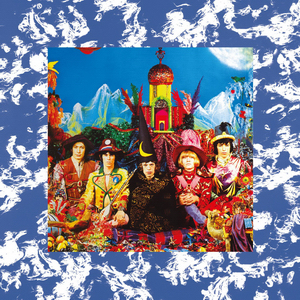
Their Satanic Majesties Request (1967)

Released December 8th, 1967 on Decca Records/London Records

Peaked at #3 UK, #2 US

Singles:

In Another Land” (#87 US)

She’s A Rainbow” (#25 US)

As the Summer of Love dragged on, things were not so rosy in England.  By the end of the year, 3/5 of the Stones were facing drug charges following a sharp crackdown on pop stars and drugs by the London police.  The recording sessions for Their Satanic Majesties Request would drag on, the slow speed compounded by the band’s prodigious drug use and a large increase in the number of ‘guests’ each member was bringing by the studio.  The result, released in December, was a jumbled mess of an album, a response to Sgt Peppers in name only.  The band’s antics caused their producer, Andrew Oldham, to leave partway through; the remaining sessions were produced by the band themselves, which did them no favours.  Contemporary critics were savage on it, sharply divided as to whether it held any worth and derisive of its obvious debts to the Beatles, Beach Boys, and Kinks.  While there are a couple of admittedly great songs on it, it remains by and large a low point in their catalog.

Next Up: The Seventies